A Practical Guide to Modern Test Strategy Documents
Stop writing test strategy documents no one reads. This guide offers actionable advice and proven frameworks to create living strategies that align your team.
Discover the differences between testing strategy vs test plan with practical examples to boost your QA outcomes.
Automate and scale manual testing with AI ->
To really get the difference between a testing strategy and a test plan, you first have to understand the multifaceted role of software testing—it’s about a lot more than just squashing bugs.
Put simply, a Test Strategy is the high-level vision for quality in your organization. It’s the ‘why’ behind your testing efforts and stays pretty consistent from one project to the next. On the other hand, a Test Plan is the detailed, project-specific blueprint. It’s the ‘how, when, and who’ for a single release or feature.
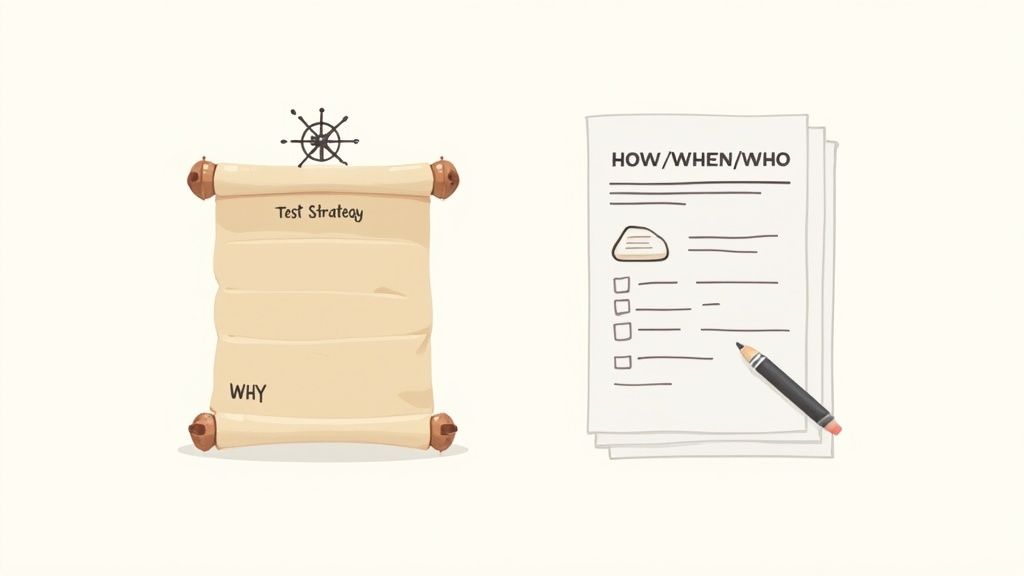
I like to think of it like this: your test strategy is the constitution, and your test plan is the specific law. The constitution (strategy) lays out the big, guiding principles that don’t really change. The law (plan) is then written to tackle a specific situation, but it must always operate within the framework of that constitution.
This isn’t just a theoretical distinction; it grew out of necessity. Back in the late 1990s, as software grew more complex, teams realized they needed a consistent, high-level framework to guide quality across the board. That’s when the idea of a separate test strategy really took hold, while the test plan remained the tactical, in-the-trenches document for getting things done.
A solid test strategy answers the big-picture questions for the whole company:
The test plan is where those high-level ideas hit the ground running for a real project. It translates the abstract principles into concrete actions, spelling out schedules, assigning resources, and listing the specific features to be tested for the next release.
This table cuts right to the chase, showing how each document plays a unique yet connected role in delivering quality software.
| Attribute | Test Strategy (The ‘Why’) | Test Plan (The ‘How’) |
|---|---|---|
| Scope | Organizational or Program-level. | Project or release-specific. |
| Lifecycle | Long-term, static, and rarely changes. | Short-term, dynamic, and changes with the project. |
| Objective | Defines the overall approach and standards for testing. | Details the specific testing activities, scope, and resources. |
| Ownership | Typically owned by a QA Manager or Head of Engineering. | Typically owned by a Test Lead or Project Manager. |
| Focus | High-level methods, tools, and quality principles. | Detailed schedules, features, test cases, and assignments. |
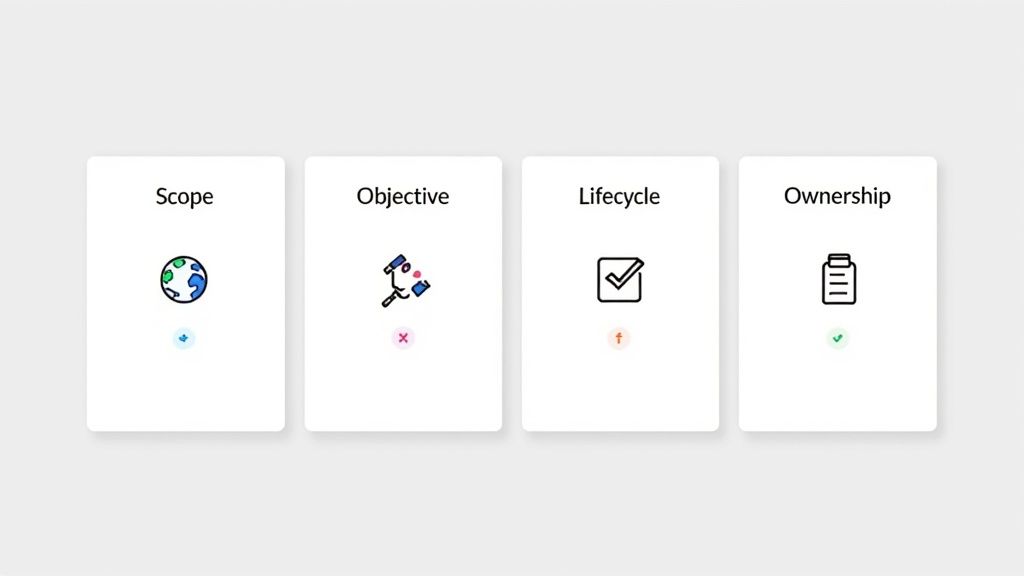
To really get to grips with how a testing strategy and a test plan work together, you have to look past the simple definitions and break down what makes each one tick. They both share the ultimate goal of improving software quality, but they play fundamentally different roles. Looking at them side-by-side, you can see how the high-level principles in a strategy are what make a project-specific plan successful on the ground.
The most obvious difference is their scope. A test strategy is the 30,000-foot view. It’s a high-level document that often covers an entire organization, a product line, or a massive program. It’s all about how you approach testing as a whole—the principles, methods, and standards that stay the same from one project to the next.
A test plan, on the other hand, is zoomed all the way in. It’s built for a specific project, whether that’s a single release, a feature update, or a two-week sprint. It takes the big ideas from the strategy and turns them into concrete, actionable steps for this particular testing effort, spelling out exactly what will be tested, who will do it, and when.
Think of it this way: a test strategy is the quality constitution for your entire organization. A test plan is the specific law passed for a single legislative session—or in our world, a single software release.
For instance, your strategy might mandate, “All customer-facing workflows must undergo automated end-to-end regression testing.” The test plan for a new e-commerce checkout feature would then list the exact test cases for that flow, like “Verify successful payment with Visa” or “Test guest checkout functionality.” The plan is where the strategy’s vision becomes reality.
The goals for each document live at different altitudes. A test strategy is about establishing a consistent benchmark for quality and efficiency that everyone can follow. It’s about setting the rules of engagement for all testing activities.
Some classic strategic objectives include:
Meanwhile, a test plan’s objectives are tactical and immediate. They’re all about validating a specific product release and getting it out the door. The plan’s job is to confirm that the software does what it’s supposed to do and is ready for customers.
Typical test plan objectives look more like this:
Another key distinction is how long each document sticks around. A test strategy is built to last. It’s a fairly static guide that you should only need to update when there’s a major shift in technology, business direction, or how your teams are structured. A solid strategy can stay relevant for years, giving you a stable foundation for countless projects.
The test plan, however, is temporary by design. It’s a living document that’s tied directly to the lifecycle of a single project. You create it at the start, update it constantly as things change, and then it’s essentially archived once the project is done. The next project gets a brand-new test plan.
This difference is what makes the whole system work. The strategy’s stability means teams aren’t reinventing the wheel every time, while the plan’s flexibility lets them adapt to the unique chaos of each individual release.
Who owns these documents says a lot about their place in the hierarchy. A test strategy almost always comes from the top. It’s written and maintained by senior leaders in the quality or engineering organization.
You’ll typically see these folks in charge:
This high-level ownership guarantees the strategy aligns with what the business is trying to achieve and gives it the weight to be enforced across different teams.
The test plan is a tactical tool, so its ownership is much closer to the action. A Test Lead or QA Manager assigned to that specific project is responsible for it. They write it, keep it updated, and make sure it gets done. This puts the person accountable for the project’s quality in direct control of the plan to achieve it. They follow the guidelines from the strategy but have the freedom to tailor the plan to fit the project’s needs. This clear split creates a powerful dynamic where the big-picture vision guides the day-to-day execution.
Knowing the textbook definitions of a test strategy versus a test plan is one thing. Seeing how they actually work in the wild is another. The way these documents are created, used, and valued shifts dramatically depending on a company’s size, culture, and how mature its development process is.
Let’s walk through three common scenarios to see how the theory plays out in the real world.
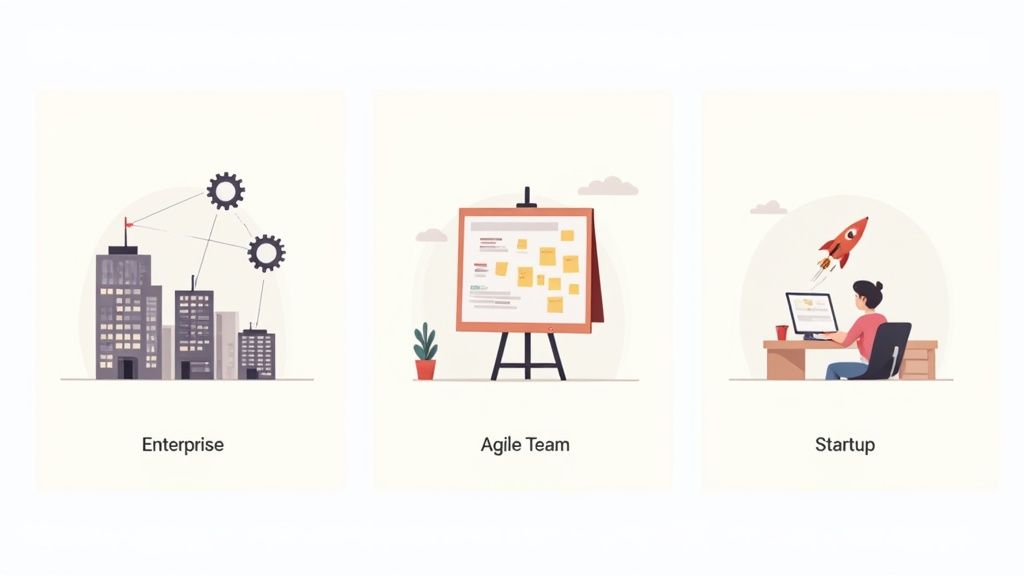
Picture a massive financial institution. We’re talking thousands of developers and hundreds of separate applications. In this world, the Test Strategy is a formal, high-level document, likely signed off by the Head of Quality Engineering. It’s a core piece of their governance framework, not just a guideline.
This strategy document lays down the law, mandating non-negotiable standards across the board to keep things consistent and compliant.
In this environment, a Test Plan for a new mobile banking feature is a detailed, tactical blueprint. The project’s Test Lead is responsible for creating it, and you can bet it has to follow every rule laid out in the strategy. It takes those big, enterprise-wide mandates and turns them into concrete actions, spelling out schedules, who’s doing what, and exactly which user stories are getting tested in the next release.
Now, let’s switch gears to a mid-sized SaaS company with a tight-knit, 10-person agile team working in two-week sprints. They don’t have a 50-page strategy document gathering dust on a server. Instead, their Test Strategy is a living page in their Confluence or Notion space, owned and updated by the whole team.
This agile strategy is lightweight and built on shared principles, not rigid rules.
For an agile team, the strategy isn’t about top-down enforcement. It’s about creating shared agreements that help them move fast without breaking things. It answers one simple question: “How do we, as a team, agree to test?”
Their strategy might be as simple as a few bullet points:
The Test Plan here is even leaner. It’s often not a separate document at all. Instead, it’s woven directly into their project management tool, like Jira. For a sprint focused on a new dashboard, the “plan” is just a collection of testing tasks attached to the user stories. These tasks define what needs to be tested, who owns it, and when it’s due—all within the context of the sprint. It makes planning a natural part of their daily work.
You can learn more about this practical approach in our guide on effective strategies for test planning.
Finally, imagine a five-person startup racing to build its first product. Speed is everything, and bureaucracy is the enemy. Here, the idea of a formal Test Strategy is almost laughable. It might be a simple one-pager or even just a slide in their investor deck outlining their commitment to quality.
The goal is to provide just enough direction to keep everyone on the same page without slowing them down. The strategy is all about fundamental principles.
The Test Plan for their MVP launch is just as pragmatic. It’s probably a shared checklist in Trello or a Google Sheet. It lists the key features, assigns an owner to each, and has a simple pass/fail checkbox. This gives them just enough structure to make sure the important stuff works, perfectly matching their need for speed and constant feedback.
It’s easy to dismiss a testing strategy and a test plan as just more paperwork. But their real value shines when you connect them to tangible business outcomes. These documents aren’t bureaucratic fluff; they’re your primary tools for managing resources, heading off risks, and protecting your bottom line. How you handle this documentation directly impacts project costs, timelines, and your team’s ability to navigate the unexpected.
A solid test strategy is a long-term investment in pure efficiency. When you standardize tools, environments, and quality benchmarks across the whole company, you stop reinventing the wheel on every project. Teams aren’t wasting time debating automation frameworks or what defines a “critical” bug anymore. That upfront alignment pays off again and again.
This decision tree gives you a clear picture of how both strategy and planning affect your resources and exposure to risk.
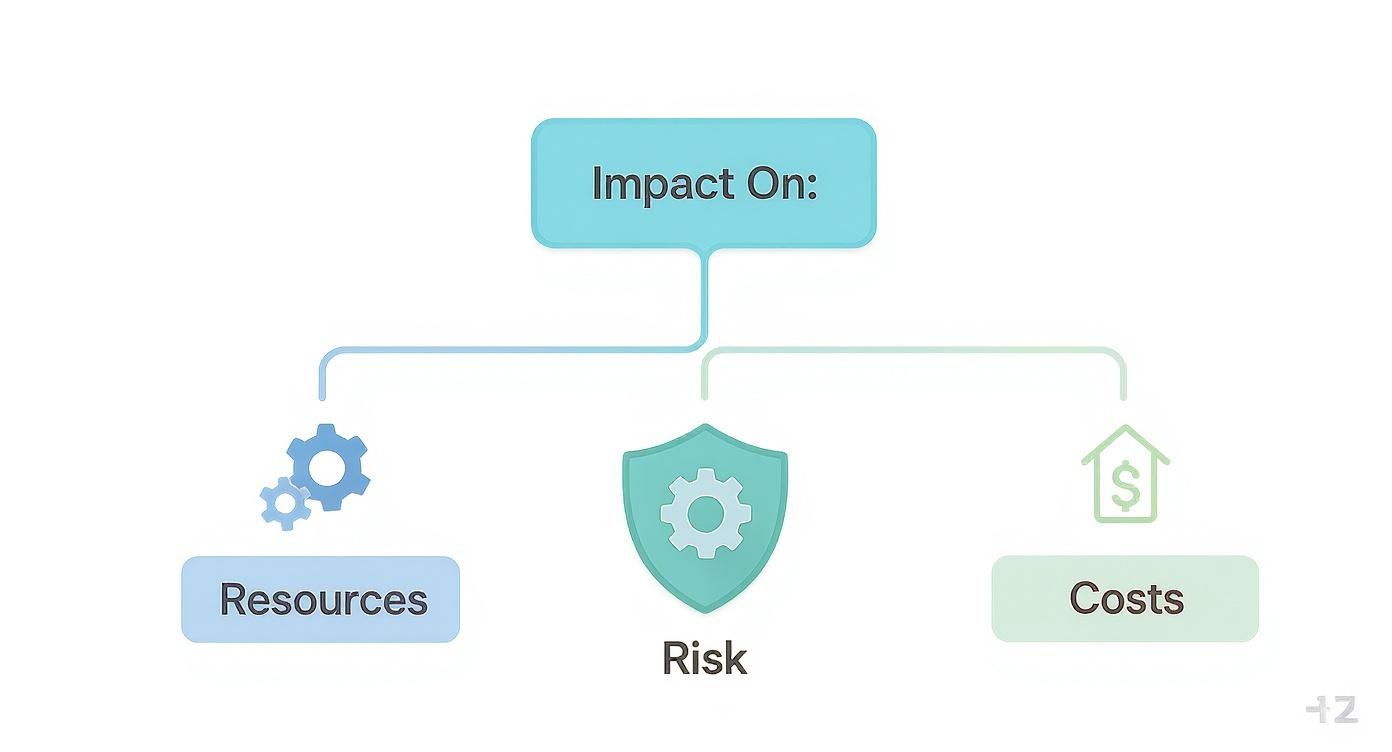
As you can see, both documents hit the budget, but at different scales. The strategy sets the financial guardrails for the entire organization, while the plan manages the costs of a single project.
Think of a test strategy and a test plan as having different investment timelines. A 2021 study of Fortune 500 companies revealed that building a comprehensive test strategy took an initial investment of about 200 person-hours. In comparison, a detailed test plan for a single release cycle required around 100 person-hours.
Sure, the strategy is a heavier lift at the start. But it pays for itself by cutting down on redundant work and making future test plans faster to create, ultimately leading to lifecycle cost savings of up to 15%. That initial effort prevents resource drain down the road, giving every project a head start with established best practices. It also makes long-term budgeting and resource allocation far more predictable.
A Test Strategy is an exercise in risk prevention at a portfolio level. It answers the question, “How do we build a system that minimizes quality-related surprises across all our projects?”
While the strategy is all about the big picture, the test plan is your frontline tool for managing immediate, project-specific risks. It takes the high-level principles from the strategy and turns them into a concrete schedule with names, dates, and dollar amounts attached. This is where you identify and get ahead of the things that could derail this specific release.
A good test plan tackles tactical risks head-on, such as:
This project-level focus is critical. The plan ensures your testing effort is aimed squarely at the highest-risk parts of the current release, making every hour and dollar count. You can explore how different document styles handle these details in our article on traditional vs modern approaches to test plans.
In the end, these two documents work as a team to deliver real financial benefits. The test strategy drives down long-term operational costs by making your whole organization more efficient. At the same time, the test plan minimizes the immediate financial risks tied to a single software release.
By managing resources and risk at both the strategic and tactical levels, this documentation helps you ship faster and spend less on rework. This two-pronged approach elevates QA from a simple cost center to a strategic partner that actively protects and grows the business. Once managers see that connection, the investment in proper documentation becomes an obvious win.
Deciding between a formal testing strategy, a detailed test plan, or a lightweight mix of both isn’t about finding the “right” answer—it’s about finding what’s right for your team. There’s no universal solution here. The real goal is to match your documentation to your team’s reality, making sure it acts as a useful guide, not a bureaucratic burden.
Trying to force a 50-page strategy on a five-person startup is just as counterproductive as having no documentation in a highly regulated enterprise. You’re looking for that sweet spot where you have enough clarity to move forward without creating unnecessary friction. This framework should help you find that balance.
Your team’s makeup, the complexity of your project, and the pressures of your industry are what really dictate your documentation needs. Look at these factors honestly, and you can build an approach that actually helps you.
With those factors in mind, let’s map some common scenarios to specific documentation styles. This should help turn the abstract differences between a strategy and a plan into practical, real-world choices.
The Lean Startup (Low Formality) For a small team in a race to build an MVP, speed is everything.
The Agile Scale-Up (Balanced Formality) This team has found its product-market fit and now needs more structure to grow without breaking things.
The Large Enterprise (High Formality) In a big, complex organization, consistency and managing risk are the top priorities.
The ultimate goal is not to produce perfect documents but to enable effective, consistent, and predictable quality outcomes. Your documentation should be a tool that helps you achieve that, not a box you have to check.
At the end of the day, having both a clear strategy and a detailed plan usually delivers the best results. A 2023 industry report found that 78% of firms with a documented test strategy also had a 25% lower defect escape rate after release. When they paired that strategy with detailed test plans for their projects, those same companies saw a 40% improvement in completing testing on time. You can find more details about these test documentation findings on practitest.com. This data really highlights the power of combining high-level guidance with project-specific execution.
Even with clear definitions, the line between a testing strategy and a test plan can get blurry. How these documents are used often depends on company culture and the type of project you’re working on. Let’s clear up some of the most common points of confusion once and for all.
You can, but it’s not a great idea if you’re aiming for scalable quality. A team can definitely hammer out a detailed test plan for one specific project without a formal, overarching strategy document. This happens all the time in startups or on brand-new projects where a broader quality framework just doesn’t exist yet.
The problem with this approach is that you’re constantly reinventing the wheel. Without a strategy to guide you, every new test plan starts from zero, which often leads to inconsistent tools, fluctuating quality standards, and a lot of wasted effort.
A test plan without a strategy is like building a house without a city-wide building code. You might end up with a functional house, but you’ll lack consistency, shared standards, or a long-term vision for how it fits into the larger community.
Even a simple, informal strategy provides the guardrails that make individual test plans more effective and much faster to create.
The test strategy always comes first. Think of the strategy as the high-level blueprint that sets the principles and standards for all your testing activities. The test plan is then built from that strategy, applying its rules to a specific project. You can’t really figure out the “how” (Test Plan) until you’ve defined the “why” (Test Strategy).
In a mature organization, the workflow is straightforward:
Even if you’re a startup writing your very first testing document, the first step should be to outline a mini-strategy. It could just be a section at the top of your test plan, but it establishes the foundational rules before you get lost in project details.
Yes, absolutely—but they look very different. Agile practices favor living, lightweight documents over the static, exhaustive binders of the past. For an agile team, the test strategy is often a single, concise page in a shared space like Confluence, outlining core principles like their automation approach or the team’s “Definition of Done.”
The test plan, on the other hand, is almost never a separate, formal document. Instead, it’s woven directly into the team’s day-to-day workflow. Think of testing-specific tasks and acceptance criteria attached directly to user stories in a tool like Jira. The “plan” becomes a dynamic part of each sprint’s backlog, not a standalone artifact that gets filed away.
So, while agile teams still need both strategic direction and a tactical plan, they express them in a way that prioritizes speed and flexibility.
Ready to turn your testing strategy into action? With TestDriver, you can generate comprehensive end-to-end tests from a simple prompt, bringing your high-level quality goals to life without the heavy scripting. See how AI can accelerate your test planning and execution at https://testdriver.ai.
Stop writing test strategy documents no one reads. This guide offers actionable advice and proven frameworks to create living strategies that align your team.
Clearly understand the difference in the test plan vs test strategy in software testing. This guide covers roles, scope, and when to use each for better QA.
Explore our definitive guide on white box vs black box testing. Learn key differences, practical applications, and how to choose the right strategy.
Discover how quality assurance in software development works. Learn modern QA processes, key testing types, and how AI is revolutionizing software delivery.
TestDriver runs every pull request in a real desktop sandbox, finds bugs, and builds regression tests - right from your repo.