A Practical Guide to Quality Assurance in Software Development
Discover how quality assurance in software development works. Learn modern QA processes, key testing types, and how AI is revolutionizing software delivery.
Build a future-proof QA skill set for 2025. Explore our roundup of 8 essential technical and soft skills, with examples, resources, and evaluation tips.
Automate and scale manual testing with AI ->
In a world of continuous integration pipelines, complex microservices, and AI-driven development, the role of Quality Assurance is more critical and dynamic than ever. Thriving in this environment isn’t just about finding bugs; it’s about preventing them, optimizing processes, and championing quality from the initial code commit to the final customer click. A powerful QA skill set is no longer a simple checklist of tools. It’s a strategic blend of deep technical expertise and crucial soft skills that enables you to navigate complexity, collaborate effectively, and deliver tangible business value.
This guide moves beyond the obvious to provide a prioritized, actionable roundup of the 8 skills that define a top-tier QA professional today. Forget generic advice and surface-level tips. Here, we’ll dive into the specifics of what it takes to build a truly effective QA skill set that can withstand technological shifts and drive product excellence.
For each of the core competencies covered, you will find:
We will explore everything from advanced test case design and automated testing to the often-underestimated power of domain knowledge and critical thinking. This is your blueprint for building a future-proof career in quality assurance.
At the heart of any effective QA skill set lies the ability to design and develop robust test cases. This foundational skill involves systematically translating software requirements into structured, repeatable test scenarios that verify functionality, performance, and user experience. It’s the disciplined process of identifying what to test, how to test it, and what constitutes a successful outcome. Without well-designed test cases, testing becomes chaotic, coverage becomes uncertain, and critical defects can easily slip into production.
This discipline is fundamental because it provides the blueprint for all testing activities, whether manual or automated. Companies like Netflix rely on meticulous test cases to validate streaming features across a dizzying array of devices and network conditions. Similarly, Google’s systematic approach ensures that every new Gmail feature undergoes rigorous, documented validation before release.
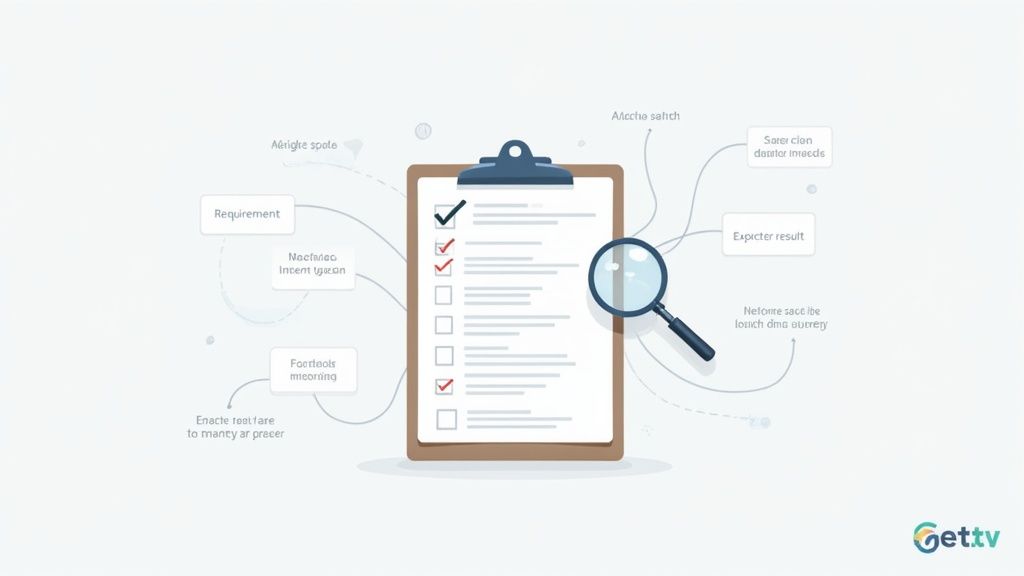
Effective test case design ensures comprehensive coverage, preventing gaps where bugs can hide. It creates a clear, documented record of testing efforts, which is invaluable for regression testing, team collaboration, and onboarding new members. By defining precise steps and expected outcomes, these test cases eliminate ambiguity and make test execution consistent and reliable. For a detailed guide on structuring your tests effectively, you can learn more about how to write test cases.
To elevate this critical component of your QA skill set, focus on structured techniques and clear documentation.
A cornerstone of the modern QA skill set is expertise in automated testing. This technical skill involves creating, maintaining, and executing test scripts using specialized tools and frameworks. Its purpose is to automate repetitive, time-consuming test cases, which dramatically increases execution speed, broadens test coverage, and enables continuous testing within CI/CD pipelines. By automating regression suites and high-frequency checks, teams can focus manual testing efforts on more complex, exploratory scenarios.
This capability is non-negotiable in today’s fast-paced development cycles. Companies like Etsy leverage Selenium WebDriver to automate web UI tests, ensuring a consistent user experience across their marketplace. Similarly, Uber relies on frameworks like Appium to validate its mobile app’s functionality across countless devices and operating systems. This shift from manual to automated execution is what allows tech giants to deploy code multiple times a day with confidence.
Automated testing provides an unparalleled return on investment by freeing up human testers from monotonous tasks. It delivers faster feedback to developers, catching regressions almost immediately after code is committed. This speed is critical for agile and DevOps environments, as it makes continuous integration and delivery feasible. Furthermore, automated scripts execute tests with precision every time, eliminating the risk of human error and ensuring consistent validation of core functionalities.
To build this crucial part of your QA skill set, focus on creating resilient, maintainable, and scalable automation frameworks.
A critical part of any QA skill set is the ability to expertly manage the entire defect lifecycle. This goes far beyond simply finding bugs; it involves the systematic process of identifying, documenting, reproducing, tracking, and verifying the resolution of software defects. It is the core communication channel between QA and development, ensuring that issues are understood, prioritized, and fixed efficiently. Without a structured defect management process, critical issues can get lost, development efforts can be wasted on poorly described bugs, and product quality suffers.
This systematic approach is essential for maintaining momentum and clarity in complex projects. For instance, Microsoft’s legendary defect tracking system for Windows development ensures that millions of lines of code can be updated with a clear, auditable trail of bug fixes. Similarly, major platforms like Adobe and Facebook use sophisticated defect triage and metric systems to make data-driven decisions about product releases, directly linking bug severity to business impact.
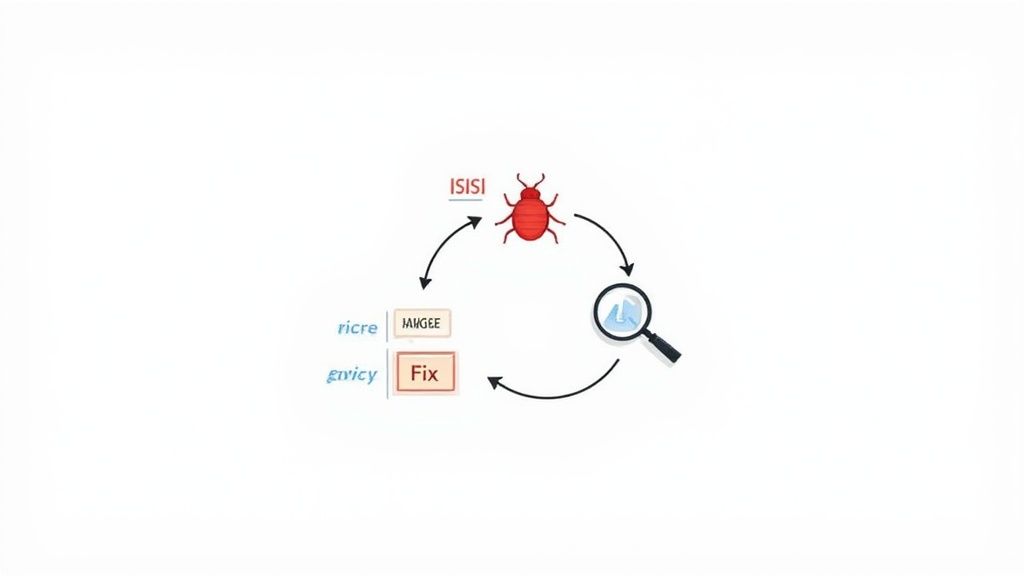
Effective defect management creates a single source of truth for all product issues, preventing miscommunication and ensuring accountability. It provides valuable data that can highlight recurring problems, identify areas of the application that are brittle, and ultimately improve the development process itself. By clearly defining the severity and priority of each defect, QA professionals help teams focus their limited resources on the issues that matter most to users and the business.
To master this component of your QA skill set, focus on clarity, detail, and consistent process adherence.
Beyond technical execution, an elite QA skill set is built on a foundation of critical thinking and analytical prowess. This is the ability to question assumptions, dissect complex systems, and logically deduce potential problems before they ever become bugs. It’s the mental discipline that allows a QA professional to move beyond simply following a test script and start thinking like a user, a developer, and even a malicious actor to uncover hidden vulnerabilities and edge cases.
This intellectual rigor is what separates good testers from great ones. For instance, security researchers who discover zero-day vulnerabilities do so not by chance, but through deep, critical analysis of system architecture. Likewise, QA teams at Apple apply this skill to foresee complex hardware-software integration issues long before a new iPhone reaches production, ensuring a seamless user experience from the very first power-on.
Critical thinking is the engine of effective quality assurance. It empowers testers to proactively identify risks rather than just reactively finding bugs that surface from pre-written scripts. This analytical mindset ensures that testing is not a superficial check but a deep investigation into the software’s stability, security, and usability. It helps in prioritizing tests, understanding the root cause of failures, and providing insightful feedback that leads to a fundamentally better product.
To sharpen this essential component of your QA skill set, integrate investigative techniques into your daily testing process.
A superior QA skill set extends far beyond technical execution; it hinges on the ability to communicate findings and collaborate effectively. This crucial soft skill involves articulating complex technical issues to diverse audiences, from developers to product managers and business stakeholders. It’s about translating bug reports and test results into a language that highlights business impact, drives action, and champions a collective commitment to quality. Without strong communication, even the most critical bug discovery can get lost in translation or deprioritized.
This skill is the connective tissue that integrates quality into the entire development lifecycle. Companies like Spotify build their entire engineering culture around cross-functional “squads” where constant communication between QA, developers, and product owners is non-negotiable. Similarly, Slack’s success is partly built on a culture of transparent, frequent communication, ensuring quality concerns are everyone’s responsibility, not just the QA team’s.

Effective communication ensures that test findings lead to meaningful action. It prevents the “us vs. them” mentality that can sometimes arise between development and QA teams, fostering a shared sense of ownership. By clearly linking defects to user impact or business goals, QA professionals can influence project priorities and advocate for the resources needed to build a stable, high-quality product. This collaborative approach turns QA from a simple gatekeeper into a strategic partner in product success.
To transform from a tester into a quality advocate, focus on clarity, context, and building strong interpersonal bridges.
Beyond technical execution, a truly impactful QA skill set includes a deep understanding of the business domain. This involves comprehending the industry, user workflows, and the specific value the software delivers to its customers. Contextual knowledge transforms a QA professional from a simple bug finder into a true quality advocate who can anticipate risks, prioritize tests based on business impact, and identify scenarios that technical specifications might miss.
This skill is fundamental because it provides the “why” behind the “what” of testing. For example, a QA professional in healthcare must understand HIPAA compliance and patient safety workflows to design meaningful tests that go beyond simple button clicks. Similarly, a fintech QA expert needs to grasp PCI DSS compliance and the intricacies of financial transactions to effectively validate a payment gateway. Without this context, testing remains superficial and fails to protect the business from its most significant risks.
Domain knowledge enables QA to prioritize effectively, focusing testing efforts on the most business-critical features and user journeys. It empowers them to identify subtle but severe edge cases that are only apparent with a deep understanding of how users interact with the product in the real world. This business acumen ensures that the testing strategy aligns directly with business goals, protecting revenue streams and brand reputation by preventing critical failures.
To build this essential component of your QA skill set, immerse yourself in the business context and actively seek out information beyond the technical specs.
Beyond basic functionality, a crucial aspect of the modern QA skill set is the ability to validate how an application behaves under stress. Performance and load testing is a specialized discipline focused on evaluating a system’s responsiveness, stability, and scalability under various user load conditions. It’s the practice of simulating real-world traffic to identify performance bottlenecks, measure response times, and ensure the application can handle peak usage without degrading or failing. Without this, an application that works perfectly for one user might crash during a product launch or sales event.
This skill is mission-critical for companies where performance directly impacts revenue and user retention. Amazon, for example, rigorously load tests its infrastructure to handle the massive traffic surges of Black Friday, preventing costly outages. Similarly, Netflix employs sophisticated performance testing and chaos engineering to ensure its streaming services remain responsive for millions of concurrent viewers across a global network. This proactive approach to quality at scale is what separates a good user experience from a great one.
Performance testing provides critical insights into an application’s architecture and infrastructure, ensuring it meets non-functional requirements like speed and reliability. It builds user trust by preventing slowdowns and crashes during high-traffic periods, directly impacting user satisfaction and business success. By identifying and resolving bottlenecks before they affect users, this skill saves companies from reputational damage and lost revenue. A robust QA skill set must include the ability to guarantee quality not just in features, but in performance.
To add this valuable discipline to your QA skill set, focus on systematic measurement and realistic simulation.
In the fast-paced world of software development, technology is in a constant state of flux. Adaptability and a commitment to continuous learning are not just beneficial soft skills; they are essential survival traits for any QA professional. This mindset involves the capability to quickly grasp and apply new technologies, tools, frameworks, and methodologies. Without it, a QA professional’s skill set can become obsolete, hindering their ability to contribute effectively as project requirements and technology stacks evolve.
This trait is fundamental because the testing landscape is perpetually changing. QA professionals who once mastered Selenium are now learning modern frameworks like Cypress and Playwright to keep pace with front-end development. Similarly, the shift from monolithic, waterfall-based QA to integrated testing within agile and DevOps pipelines requires a complete re-evaluation of processes and tools. Embracing change is no longer optional; it is a core competency that defines an effective QA skill set.
A commitment to continuous learning ensures a QA professional remains relevant and valuable. It enables teams to adopt more efficient testing practices, such as leveraging AI-powered tools like Applitools for visual regression or cloud platforms like BrowserStack for cross-browser testing. This adaptability allows QA to be a proactive partner in innovation rather than a bottleneck. It fosters resilience, problem-solving, and the ability to pivot quickly, which are critical for maintaining quality in dynamic development environments.
To cultivate this crucial component of your QA skill set, integrate learning into your regular work habits and professional development.
| Capability | Implementation Complexity 🔄 | Resource Requirements ⚡ | Expected Outcomes ⭐📊 | Ideal Use Cases 💡 | Key Advantages ⭐ |
|---|---|---|---|---|---|
| Test Case Design and Development | Medium — structured process; scales with app complexity | Low–Medium — QA time, documentation tools | High coverage; fewer missed defects; reusable artifacts | Requirement-driven releases; regression planning | Systematic coverage, traceability, knowledge transfer |
| Automated Testing Expertise | High — framework selection, scripting, maintenance | High — automation engineers, CI/CD infra, test environments | Fast, repeatable execution; improved regression ROI | Repetitive tests, CI pipelines, cross-browser/device checks | Speed, reduced manual effort, scalability |
| Defect Management and Reporting | Medium — process + tooling + discipline | Low–Medium — tracking tools, triage owners | Clear visibility; data-driven fixes; trend metrics | Release triage, cross-team coordination, quality gates | Better prioritization, reduced duplicates, accountability |
| Critical Thinking and Analytical Skills | Medium — cognitive effort; no fixed process | Low — skilled people and dedicated analysis time | Finds edge cases; reduces costly production issues | Exploratory testing, root-cause analysis, complex logic | Detects non-obvious defects; deep system insight |
| Communication and Collaboration | Low–Medium — depends on culture and rituals | Low — meeting time, reporting artifacts | Faster issue resolution; aligned teams; stronger quality culture | Cross-functional projects, stakeholder reporting | Builds trust, speeds decisions, clarifies impact |
| Domain Knowledge and Business Understanding | High — extensive learning and context acquisition | Medium — training, domain docs, shadowing users | Focused testing; identifies business-critical defects | Regulated industries, financial/healthcare workflows | Better prioritization; higher ROI; risk-aware testing |
| Performance and Load Testing | High — scenario design and complex analysis | High — load generators, environments, monitoring | Bottleneck identification; capacity planning; SLA validation | High-traffic systems, release readiness, scaling events | Prevents outages; improves UX at scale; cost optimization |
| Adaptability and Continuous Learning | Medium — ongoing effort; no one-off implementation | Low–Medium — learning resources, time allocation | Team stays current; faster adoption of new tools/methods | Technology migrations, adopting modern test tools | Future-proofing, faster onboarding, continuous improvement |
Throughout this guide, we’ve journeyed through the multifaceted world of the modern qa skill set. From the meticulous art of Test Case Design and the technical precision of Automated Testing to the crucial soft skills of Communication and Critical Thinking, each element is a vital thread in the fabric of high-quality software delivery. Mastering these eight core areas is not a one-time achievement but a continuous process of refinement, adaptation, and growth.
The enduring principles remain constant: understand the user, anticipate risks, communicate clearly, and verify relentlessly. However, the landscape in which we apply these principles is undergoing a radical transformation, driven by the power of artificial intelligence.
The traditional path to building a robust qa skill set involved long hours spent on repetitive, manual tasks. Writing detailed test scripts, manually executing regression suites, and meticulously documenting every step consumed the bulk of a QA professional’s time. While these activities are necessary, they often leave little room for the strategic, high-impact work that truly defines an exceptional quality advocate.
This is where the new paradigm of AI-powered testing emerges. Tools are evolving from simple script recorders to intelligent partners that can understand intent and generate complex test logic autonomously. This shift elevates the role of the QA engineer from a scriptwriter to a test strategist.
Key Takeaway: The value of a modern QA professional is no longer measured by the number of test cases they can write manually. It is measured by their ability to define quality strategy, analyze complex systems, and leverage intelligent tools to achieve comprehensive test coverage efficiently.
Adopting AI in your testing workflow does not make your existing skills obsolete; it supercharges them. Think of it as a force multiplier for every competency we’ve discussed.
Embracing this evolution is the final, essential component of a future-proof qa skill set. It’s about working smarter, not just harder. By offloading the mechanical aspects of test creation to intelligent automation, you unlock your potential to contribute more strategically, ensuring that quality is not just a phase in the lifecycle but an integral part of the product’s DNA. This is how you transition from a gatekeeper of quality to a true enabler of innovation and speed.
Ready to see how AI can transform your testing process and amplify your qa skill set? Experience the future of end-to-end automation with TestDriver. Stop scripting and start shipping faster by turning simple prompts into powerful, comprehensive tests in minutes. Explore TestDriver and accelerate your journey to becoming a strategic quality leader.
Discover how quality assurance in software development works. Learn modern QA processes, key testing types, and how AI is revolutionizing software delivery.
Discover 10 automated software testing best practices for 2026. This guide covers CI/CD, test design, and AI-driven strategies for modern QA teams.
Learn how to build a test strategy doc that aligns teams and delivers results. Get actionable steps on scope, tools, AI, and metrics.
Master how to write the test cases with this practical guide, sharing real-world strategies for reliable software testing.
TestDriver runs every pull request in a real desktop sandbox, finds bugs, and builds regression tests - right from your repo.